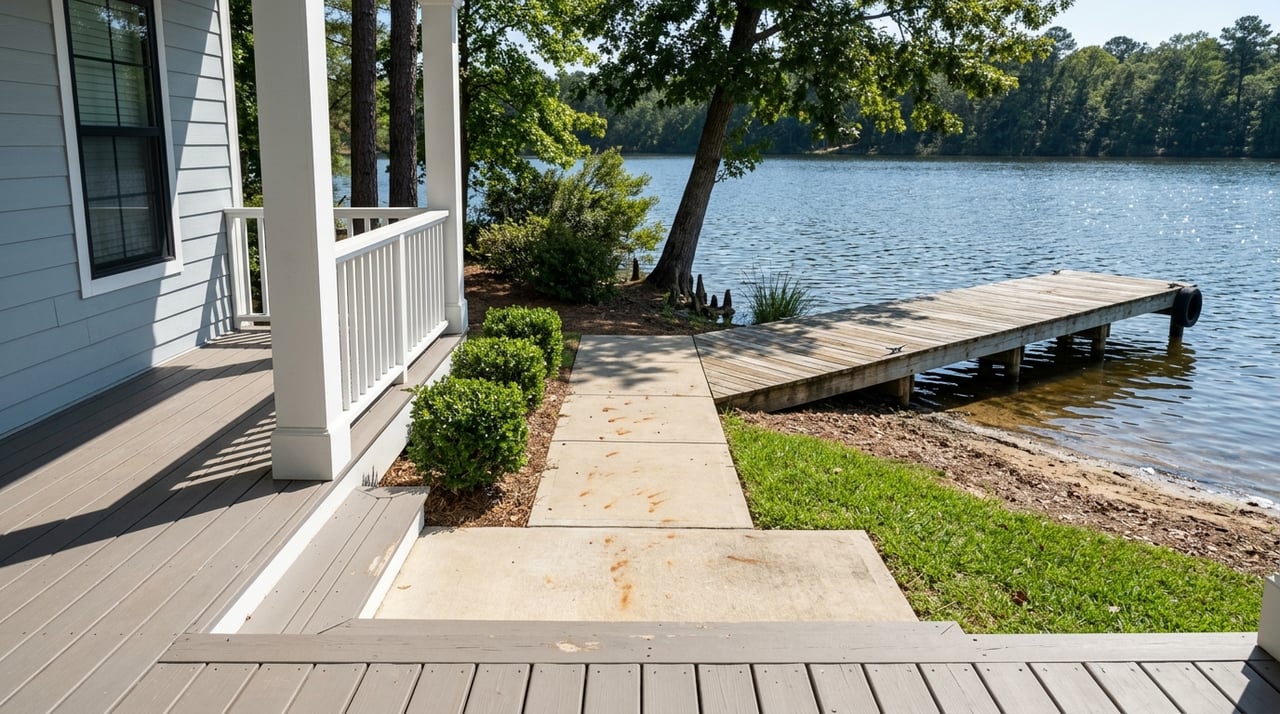
If you have been dreaming about a weekend place on Lake Eufaula, you are not alone. A second home here can offer the lake lifestyle you want, but the smartest buyers know that waterfront ownership comes with a few extra layers beyond the view. Before you fall in love with a lot or lakeside house, it helps to understand pricing, taxes, flood insurance, dock rules, and upkeep so you can buy with confidence. Let’s dive in.
Lake Eufaula second-home pricing
One of the first surprises for many buyers is how wide the price range can be. Current waterfront listings in Eufaula range from lots around $45,000 to homes priced up to $2.695 million.
That spread matters because many buyers are really choosing between two very different paths: a buildable waterfront lot or a finished second home. Realtor.com also reports Eufaula’s overall median listing home price at $310,000, but true waterfront pricing can land well below or above that depending on shoreline access, improvements, and whether a property already has a usable setup at the water.
Many homes appear in the roughly $279,900 to $479,500 range, while higher-end lake properties can push into the $898,000 to $1.1 million range. That makes it important to compare not just the house itself, but the full ownership picture.
Lot or finished home?
A vacant lot may look like the lower-cost entry point, but it can bring more unknowns. You still need to confirm whether the parcel is dockable, what shoreline work may be allowed, and what carrying costs could look like once the property is improved.
A finished home may cost more upfront, but it can reduce guesswork if the home, shoreline access, and any existing dock setup have already been established. Even then, you should verify all permits and property-specific details before closing.
Taxes can change the math
For many second-home buyers, annual carrying costs are where the numbers become real. In Alabama, property taxes are based on classification, millage, and exemptions, and a second home is usually treated differently from a primary residence.
According to the Alabama Department of Revenue property tax guidance, owner-occupied residential property can qualify as Class III and be assessed at 10%. A typical second home usually does not qualify for that primary-residence treatment or homestead exemption and is generally taxed as Class II, which is assessed at 20%.
Barbour County’s 2025 millage table lists Eufaula at 42.5 mills total. Using that rate and a 20% Class II assessment, a $310,000 second home would have an illustrative annual property tax bill of about $2,635 before exemptions and fees.
That is only an estimate, but it gives you a useful planning benchmark. Exact bills can vary based on the parcel, school district, and any local charges.
Watch for location-based fees
The same county millage table notes a $30 fire fee per residence or manufactured home outside Eufaula city limits. That means the exact location of the home can affect your annual cost even before you account for insurance and maintenance.
Flood insurance deserves early attention
Flood insurance is one of the most important questions to answer before you buy a lake property. It is separate from standard homeowners insurance, and if you are using a government-backed mortgage in a high-risk flood area, it will be required.
FEMA explains that flood insurance typically has a 30-day waiting period under NFIP policies. FEMA also notes that there is no no-risk zone, and nearly 1 in 4 NFIP claims come from moderate-to-low-risk areas.
That is why it is wise to check the property address in FEMA’s Flood Map Service Center early in the buying process. Even if insurance is not required by a lender, you may decide the added protection makes sense for your comfort level.
Dock rules can make or break a property
This is where many second-home buyers need the clearest guidance. On Lake Eufaula, not every waterfront parcel is automatically dockable.
The U.S. Army Corps of Engineers describes Walter F. George Lake as a 45,181-acre reservoir with 640 miles of shoreline. The shoreline plan also explains that lake levels fluctuate for power production and navigation, which means shoreline conditions are part of ownership, not just part of the view.
Not all waterfront is private-dock eligible
The Corps allows private shoreline uses only in Limited Development areas. It does not issue private-use permits in Public Recreation areas, and it does not authorize new private structures or utilities in Protected Shoreline areas.
In plain terms, a property can be waterfront and still not support the private dock setup you imagined. That is why buyers should confirm dock eligibility before moving forward, especially when comparing vacant lots.
Existing docks need paperwork review
The Corps requires permits for private structures or activities that affect project lands or waters. That includes docks, walkways, utilities, steps, erosion control, and bank work.
Permits are also non-transferable when a property sells. If a dock already exists, the new owner must apply within 14 days after closing or remove the facility within 30 days, according to the Corps shoreline plan.
That is a major reason to verify permits, layout, and condition before you close. You do not want to assume an existing dock is fully compliant just because it is standing.
Dock size and spacing matter
The Corps states that only one permit or license may be issued per adjacent landowner for a boat docking facility. A standard dock with slip is normally capped at 680 square feet, with a possible increase to 900 square feet if justified.
A flat-T dock is normally capped at 240 square feet, with a possible increase to 360 square feet. New docks also need 50 feet of spacing from existing docks or mooring buoys at normal pool.
Lake levels affect usability
The Corps says docking facilities may be allowed in less than 4 feet of water, but owners must accept that the lake can fluctuate about five feet. During low-water periods, a dock may sit on or over dry land.
That is one of the biggest practical differences between owning inland and owning on the lake. A great view does not always guarantee year-round convenience at the shoreline.
Shoreline maintenance is part of ownership
Lakefront ownership can be rewarding, but it usually asks more of you than a typical inland second home. If erosion becomes a concern, the Corps notes that activities like minor dredging, retaining walls, and rip-rap often move through its permit process.
That means shoreline protection may become part of your budget over time. It is helpful to think about the land itself as an ongoing responsibility, not just the structure on it.
Start with a practical maintenance checklist
Even before lake-specific upkeep, routine second-home maintenance still matters. Fannie Mae’s seasonal maintenance checklist highlights items such as:
- Drainage away from the house
- Roof condition
- Gutters and downspouts
- Pest entry points
- HVAC filters
- Dehumidifier operation
- Water leaks
- Smoke and carbon monoxide alarms
For a lake property, dock maintenance belongs on that list too. The Corps also requires dock owners to maintain safe walking surfaces, anchors, reflectors, and handrails where needed.
Thinking about short-term rental income?
Some second-home buyers hope to offset costs with occasional rental income. If that is part of your plan, you should confirm the rules before you buy.
Within Eufaula city limits, the city’s short-term rental ordinance allows STRs only upon appeal and Board of Adjustments approval in most zoning districts. The ordinance also requires a permanent structure, allows lodging use only, prohibits commercial events, and sets a minimum 24-hour stay.
There is also a $150 permit fee, along with compliance requirements tied to city, county, and state business-license and revenue rules. Outside the Central Business District, the ordinance requires at least one off-street parking space for every two adults counted toward occupancy.
More than two verified complaints in a 12-month period can trigger permit revocation. In other words, rental potential should be treated as a use that needs verification, not an automatic benefit.
Questions to ask before you buy
A Lake Eufaula second home is about more than bedrooms and square footage. The best purchase is often the one that fits how you actually plan to use it.
Before you move forward, ask these practical questions:
- Is the lot dockable under current Corps rules?
- Does the property have an existing dock permit, and what happens after closing?
- What flood insurance will the address require or justify?
- How will the property be taxed as a second home?
- Is short-term rental use allowed if that matters to you?
- How much dock, shoreline, and home maintenance are you comfortable taking on?
When you answer those questions early, it becomes much easier to sort a good-looking listing from a good long-term fit.
A second home should fit your lifestyle
The right Lake Eufaula property can give you a peaceful getaway, easier weekends on the water, and a place to gather for years to come. The key is buying with a full understanding of the property itself, the shoreline rules that come with it, and the costs you will carry after closing.
That is where local guidance can make the process smoother. If you are weighing a lot versus a finished home, comparing dockable parcels, or trying to make sense of lakefront ownership in Eufaula, the team at chattahoocheerealtygroup.com is here to help you make a confident move.
FAQs
What price range should you expect for a second home on Lake Eufaula?
- Current waterfront listings in Eufaula range from about $45,000 for some lots to $2.695 million for a house, with many homes appearing in the roughly $279,900 to $479,500 range.
How are second homes in Eufaula taxed differently from primary residences?
- A typical second home usually does not qualify for the primary-residence homestead exemption and is generally taxed as Class II property in Alabama, which is assessed at 20% rather than 10% for many owner-occupied Class III homes.
Can every waterfront property on Lake Eufaula have a private dock?
- No. The Corps allows private shoreline uses only in Limited Development areas, so some waterfront parcels are not eligible for private docks.
What happens to a Lake Eufaula dock permit after a home sale?
- Shoreline permits are non-transferable, and if a dock exists, the new owner must apply within 14 days after closing or remove the facility within 30 days.
Do you need flood insurance for a second home near Lake Eufaula?
- Flood insurance is separate from homeowners insurance, and government-backed mortgages require it in high-risk flood areas, but buyers should check the address and risk details before closing.
Are short-term rentals allowed for second homes in Eufaula?
- Within Eufaula city limits, short-term rentals are not automatic and generally require appeal and Board of Adjustments approval in most zoning districts, along with compliance with permit and operational rules.